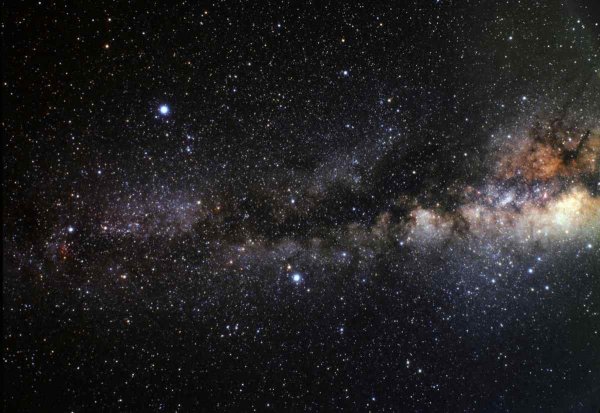
An international team mapping the universe has uncovered 11 new streams of stars in the Milky Way, each one a remnant of a dwarf galaxy or star cluster that our galaxy's gravity tore apart. The discovery, made by the Dark Energy Survey (DES), nearly doubles the number of such streams known to astronomers, who had previously cataloged only 23.
These stellar streams are essentially ribbons of debris, scattered along the orbits of their destroyed progenitors. They are faint and difficult to detect, which is why so few have been found despite decades of sky surveys. The new finds, announced by the DES collaboration, provide a rare window into how the Milky Way assembled itself over billions of years.
“We’re interested in these streams because they teach us about the formation and structure of the Milky Way and its dark matter halo,” said Nora Shipp, a graduate student at the University of Chicago, in a statement reported by Seeker. “Stellar streams give us a snapshot of a larger galaxy being built out of smaller ones.”
Most of the newly discovered streams lie in the Milky Way’s halo, a vast, roughly spherical region that extends far beyond the galaxy’s visible disk. The halo is thought to be dominated by dark matter, the invisible substance that makes up about 27% of the universe’s total mass-energy content. Although dark matter cannot be seen directly, its gravitational pull on surrounding matter betrays its presence, and stellar streams are particularly sensitive probes of that pull.
Why Streams Matter for Dark Matter Studies
Because the streams are made of stars that once belonged to smaller systems, their shapes and motions record the gravitational forces they have experienced. By measuring how these streams have been stretched and bent, astronomers can map the distribution of dark matter in the halo, tracing the invisible scaffolding that holds the galaxy together.
The DES, an international collaboration that uses one of the world’s most powerful cameras mounted on a telescope in Chile, is primarily focused on understanding dark energy and dark matter. This latest discovery is a byproduct of that broader mission, but it could have significant implications for galactic archaeology — the study of how galaxies grow by consuming smaller neighbors.
Each stream contains only a few thousand main sequence stars, a tiny fraction of the billions of stars in the Milky Way. “In big picture terms, these are small numbers of stars compared to the total number of stars in the Milky Way halo,” said Joan Najita, an astronomer at the National Optical Astronomy Observatory (NOAO), in an interview with Seeker. Yet their sparse nature is precisely what makes them useful: they are delicate tracers of the gravitational environment.
Many researchers believe the halo itself was built from the remnants of past stellar streams, pulled in from neighboring galaxies over cosmic time. If so, the newly found streams could be fossils of that ongoing assembly process, preserving information about the early universe that has long since been erased elsewhere.
Next-Generation Telescopes Will Expand the View
The discovery also sets the stage for the Large Synoptic Survey Telescope (LSST), currently under construction in Chile. Once operational in the 2020s, LSST will image the entire sky in unprecedented detail, capturing not just static images but a time-lapse view of the universe.
“In the 2020s, LSST will deliver a yet wider and deeper view of the Universe — from distant galaxies, to our Milky Way, down to the solar system,” said Adam Bolton, associate director for the Community Science and Data Center at NOAO. He told Seeker that the telescope will reveal the sky “not just as a still photo, but as a high-definition movie that will capture the rich variability of the sky.”
With such capabilities, astronomers expect to find many more stellar streams, each one adding a new piece to the puzzle of how galaxies like the Milky Way came to be. For now, the 11 new streams offer a tangible reminder that our galaxy is not a static island but a dynamic system, still bearing the scars of its violent past.
















Leave a Comment