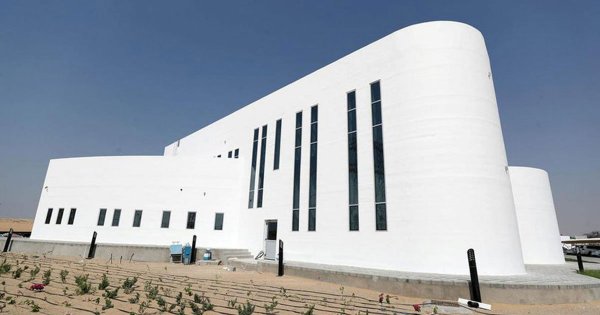
Dubai officials on Wednesday unveiled the world's largest 3D-printed two-story building in the Warsan neighborhood, a 9.5-meter-tall structure with a total floor area of 640 square meters. The concrete walls were printed in place using a massive 3D printer, a feat that underscores the technology's growing role in the construction industry.
The project required only 15 workers, half the typical workforce for a building of its size, according to a report by The National. The printing process also generated 60 percent less waste than conventional construction methods, the publication noted.
Cost savings were equally significant. Officials told The National that the technique reduced the estimated cost from Dh2.5 million (US$680,660) to less than Dh1 million (US$272,264).
Beyond efficiency, the building showcases the design flexibility of 3D printing. Its walls feature curved and angled shapes, demonstrating that the technology can produce architecturally complex forms, not just simple boxes. Dawoud Al Hajri, director general of Dubai Municipality, told The National that the building was designed with different shapes to test the printer's capabilities. “Dubai's 3D printing strategy aims to make it a global capital for this technology,” he said.
The unveiling aligns with Dubai's broader push to integrate 3D printing into urban development. The city has previously experimented with 3D-printed offices and pedestrian bridges, but this two-story structure represents a scale milestone. The technology's ability to cut labor, waste, and costs could make it an attractive option for affordable housing and rapid construction projects worldwide.
Why This Matters for Construction
The Warsan building is not just a novelty; it offers a tangible proof point for construction firms weighing the benefits of additive manufacturing. With labor shortages and material costs rising in many regions, the reduced workforce and waste figures are particularly compelling. However, experts caution that the technology is still evolving, and widespread adoption would require investment in large-scale printers and skilled operators.
For now, Dubai's move positions the emirate as a testing ground for 3D-printed architecture. The success of this project could encourage other cities to explore similar methods, potentially reshaping how buildings are designed and erected.



















Leave a Comment