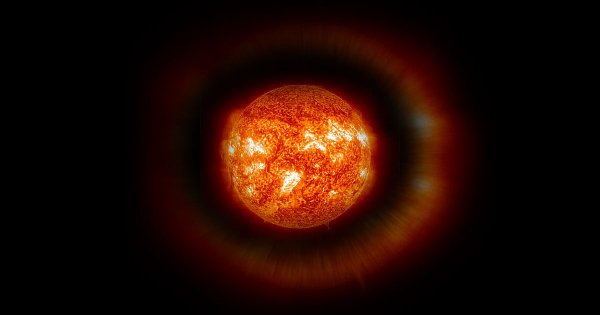
Physicists at the University of Wisconsin-Madison have crafted a swirling sphere of plasma that mimics the Sun's behavior, providing a new window into stellar dynamics. The device, informally known as the "Big Red Ball," generates plasma ejections similar to those observed on the real Sun, allowing researchers to study these phenomena up close.
The project, initiated in 2012, aims to answer long-standing questions about solar wind and the mechanisms behind coronal mass ejections—the Sun's occasional bursts of plasma into space. According to the team's findings, published this week in the journal Nature Physics, the exact processes that trigger these ejections remain poorly understood.
The miniature Sun is equipped with a powerful electromagnetic field, which helps confine the plasma into a rotating sphere. When the physicists first observed the plasma "burping"—ejecting a blob of material—they were taken by surprise. However, subsequent observations have provided a reproducible way to investigate the forces at play.
Why a Laboratory Sun?
Studying the Sun directly is challenging due to its extreme temperatures and distance. The Big Red Ball offers a controlled environment where researchers can manipulate variables and observe plasma behavior in real time. This hands-on approach could lead to better predictions of solar activity, which impacts satellite operations and power grids on Earth.
The research team's work, reported by Space.com, highlights the potential of laboratory experiments to complement observational astronomy. While the mini-Sun does not replicate the Sun's nuclear fusion, it captures the essential physics of plasma dynamics under magnetic influence.
The findings add to a growing body of knowledge about plasma behavior, with implications for both astrophysics and practical applications like fusion energy research. As the team continues to refine the Big Red Ball, they hope to uncover more about the Sun's enigmatic eruptions.
This development follows other efforts to create artificial solar analogs, such as a proposal for a molten silicon sphere that could serve as a power source, though that concept remains theoretical.
















Leave a Comment