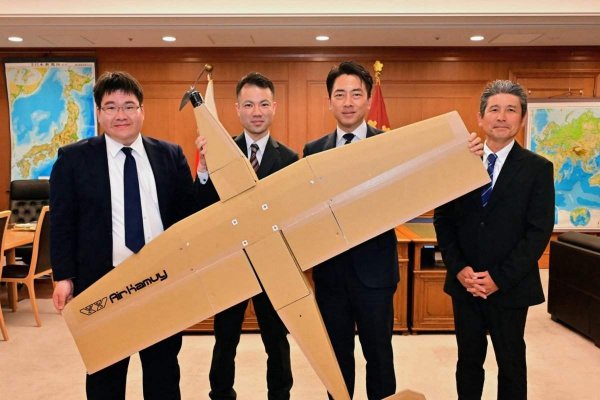
Japan's Ministry of Defense has confirmed the deployment of combat drones constructed largely from corrugated cardboard, a move that underscores a growing emphasis on affordable, mass-produced unmanned systems. Defense Minister Shinjirō Koizumi announced the initiative, stating that the Japan Maritime Self-Defense Force is already using these aircraft as targets, though whether for live-fire practice or as decoys remains unspecified.
The drone, named the AirKamuy 150, is manufactured by AirKamuy, a Japanese arms company. Unlike conventional military drones built from advanced composites and electronics, this fixed-wing aircraft is made from the same material used in shipping boxes, allowing for rapid and inexpensive production. According to a statement from Koizumi posted on X (formerly Twitter), the drones are part of the Self-Defense Force's operational inventory.
Cost is a defining feature. Each unit is priced between $2,000 and $2,500, a fraction of the $20,000 to $50,000 price tag of Iran's Shahed drones, which are already considered low-cost in the industry. This price point enables the military to acquire large numbers without straining budgets, a factor that military analysts say is increasingly critical in modern conflict scenarios where drone swarms can overwhelm traditional defenses.
Beyond affordability, the AirKamuy 150 offers practical advantages. It is foldable and can be fully assembled in about five minutes, according to an AirKamuy employee who spoke with NHK World-Japan. Despite its cardboard construction, the drone boasts a flight time of 80 minutes and a top speed of approximately 62 miles per hour, powered by a basic propulsion system that keeps costs down.
The production process is intentionally simple. AirKamuy CEO Yamaguchi Takumi told NHK that the drone can be manufactured at any cardboard plant, not just specialized aerospace facilities. This approach ensures high mass-production capability and a robust supply chain, allowing for rapid scaling if demand surges. Takumi noted that there is strong demand for low-cost drones capable of operating in large numbers over long distances, a niche the AirKamuy 150 aims to fill.
Why Cardboard Drones Matter
The shift toward cardboard drones reflects a broader trend in military procurement: prioritizing quantity and cost-effectiveness over sophisticated, expensive hardware. In recent conflicts, drones have proven decisive in surveillance and strike roles, but their high cost limits their use. By contrast, a cardboard drone can be deployed in swarms, used for decoy operations, or sacrificed in high-risk missions without significant financial loss. This aligns with Japan's defense strategy to modernize its forces while managing fiscal constraints.
The use of such drones also highlights the potential for civilian industries to contribute to defense manufacturing. Since any cardboard plant with the right die-cutting equipment can produce these drones, the supply chain is decentralized, making it harder for adversaries to disrupt production. This resilience is a key advantage in prolonged engagements.
As Japan continues to adapt its military capabilities to new threats, the adoption of the AirKamuy 150 signals a pragmatic approach to defense technology. While the drones are currently used as targets, their potential for other roles—such as surveillance or electronic warfare—remains open, depending on future operational needs.

















Leave a Comment