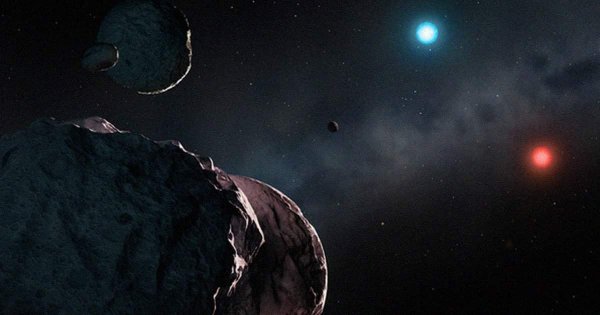
Astronomers have uncovered the remains of a planetary system that met a violent end roughly 10 billion years ago, and it sits surprisingly close to our own solar system. The star at the center of this destruction, a white dwarf designated WDJ2147-4035, is located just 90 light-years away, and its atmosphere carries the chemical fingerprints of once-Earth-like worlds that were torn apart as the star collapsed.
The findings, published in the Monthly Notices of the Royal Astronomical Society, provide a stark reminder of the eventual fate that may await our own Sun, which is also predicted to become a white dwarf after exhausting its nuclear fuel.
Lead author Abbigail Elms, a PhD student at the University of Warwick, described the discovery as evidence of the oldest stellar remnants in the Milky Way that are polluted by the remains of planets similar to Earth. "It's amazing to think that this happened on the scale of ten billion years, and that those planets died way before the Earth was even formed," she said in a statement.
What the Star's Composition Reveals
Using data from the Gaia spacecraft, the Dark Energy Survey, and the European Southern Observatory's X-shooter instrument on the Very Large Telescope, the research team determined that WDJ2147-4035 is approximately 10.7 billion years old. Of that time, it has spent 10.2 billion years cooling as a white dwarf.
The spectroscopic analysis also revealed traces of sodium, lithium, potassium, and possibly carbon in the star's atmosphere—elements that are relics of the ancient planetary system that once orbited it. These elements survived the star's transformation into a white dwarf, a process that would have destroyed any nearby planets.
The study also examined a second white dwarf, WDJ1922+0233, which was found to be polluted by material with a composition similar to Earth's continental crust. This suggests that planetary bodies with Earth-like characteristics are not unique to our solar system.
"These metal-polluted stars show that Earth isn't unique, there are other planetary systems out there with planetary bodies similar to the Earth," Elms noted.
Implications for Early Planet Formation
The observations offer a rare window into how rocky planets formed in the early universe, when the abundance of metals was much lower than it is today. The presence of these heavy elements in the white dwarfs' atmospheres indicates that planet formation was already occurring billions of years ago, even under conditions that differ from those in our own solar system's early history.
For astronomers, these findings are more than just a curiosity—they provide a direct look at the processes that can destroy planetary systems and the long-term evolution of stars like our Sun. As the Sun ages and eventually becomes a white dwarf, it could leave behind a similar trail of debris from the planets that once orbited it.
The study underscores the fragility of planetary systems and the violent end that can await worlds similar to our own, even as it offers a glimpse into the diversity of planetary systems that exist in our galaxy.
Astronomers have identified a white dwarf star 90 light-years away whose atmosphere contains remnants of Earth-like planets that were destroyed about 10 billion years ago. The findings, published in Monthly Notices of the Royal Astronomical Society, offer a glimpse into the possible future of our own solar system.















Leave a Comment